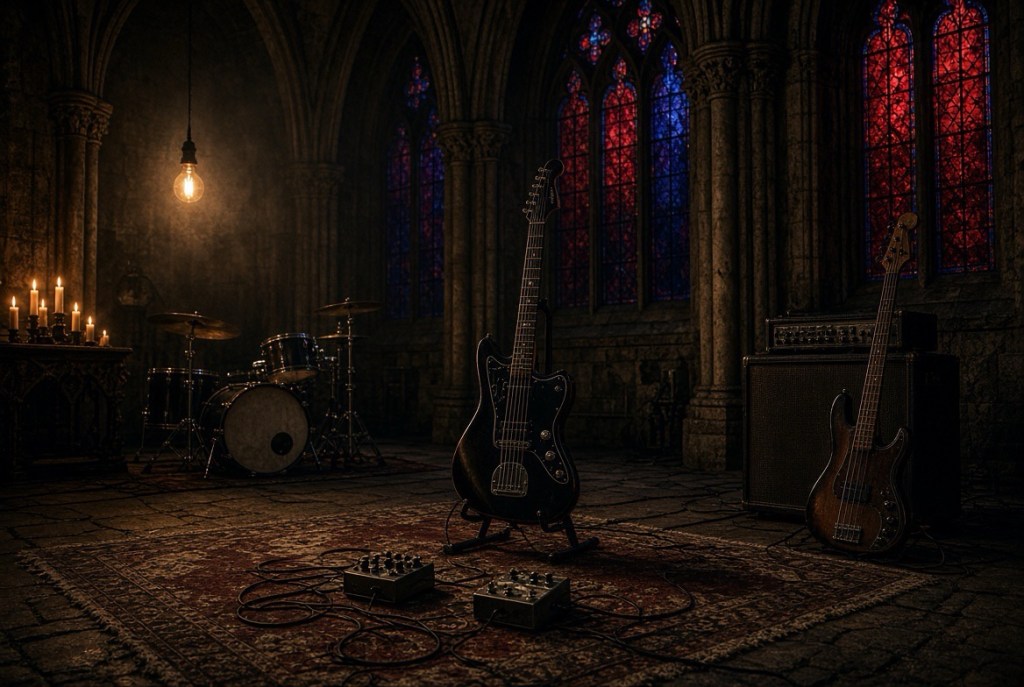
Goth music is not just “sad rock with black clothes.” At its best it is a mood first and a song second: cavernous space, a bassline that carries the melody, guitars that shimmer instead of shred, and a vocal that sounds like it is arriving from the far end of a stone hallway.
Classic gothic rock and gothic post-punk sit around 110–140 BPM, usually in minor keys (A minor, D minor, E minor, C# minor). The harmony is simple. The atmosphere does the heavy lifting. Think Bauhaus, Siouxsie and the Banshees, early The Cure, The Sisters of Mercy, Fields of the Nephilim, and later darkwave cousins rather than full gothic metal unless that is specifically what you want.
Below is a practical path from idea to mix.
The stages
1. Choose the room before you choose the riff.
Decide the space the song lives in: chapel, warehouse, nightclub, graveyard fog. That choice tells you how long the reverbs should be, how dry the drums stay, and how close the vocal sits.
2. Write a bass motif first.
In goth, the bass often is the hook. Write a short, repeating line that moves rather than parking on the root. Let it climb, fall, and leave space. If the bass is interesting on its own, the song already has a spine.
3. Add a drum pattern that leaves air.
Keep the kick and snare simple. Use toms and cymbal swells as punctuation, not constant decoration. Goth drums can feel tribal or mechanical. They should not feel busy.
4. Place guitar as texture and answer, not as a wall.
Clean or lightly overdriven parts, arpeggios, single-note figures, and delayed fragments work better than stacked power-chord walls. Leave gaps so the bass and vocal can speak.
5. Write lyrics as images, not explanations.
Night streets, empty rooms, mirrors, ritual, distance, desire, decay. Concrete pictures beat abstract diary entries. Keep lines short enough to sit on a delayed vocal.
6. Add atmosphere last.
Pads, organ, cold synth, distant choir, tape hiss, reversed swells. These should glue the track, not bury it.
7. Mix for space, then for punch.
Carve mud, park the bass and kick together, put the vocal in a hall with pre-delay so words stay readable, then widen the chorus.
Basic instruments
You do not need a cathedral full of gear.
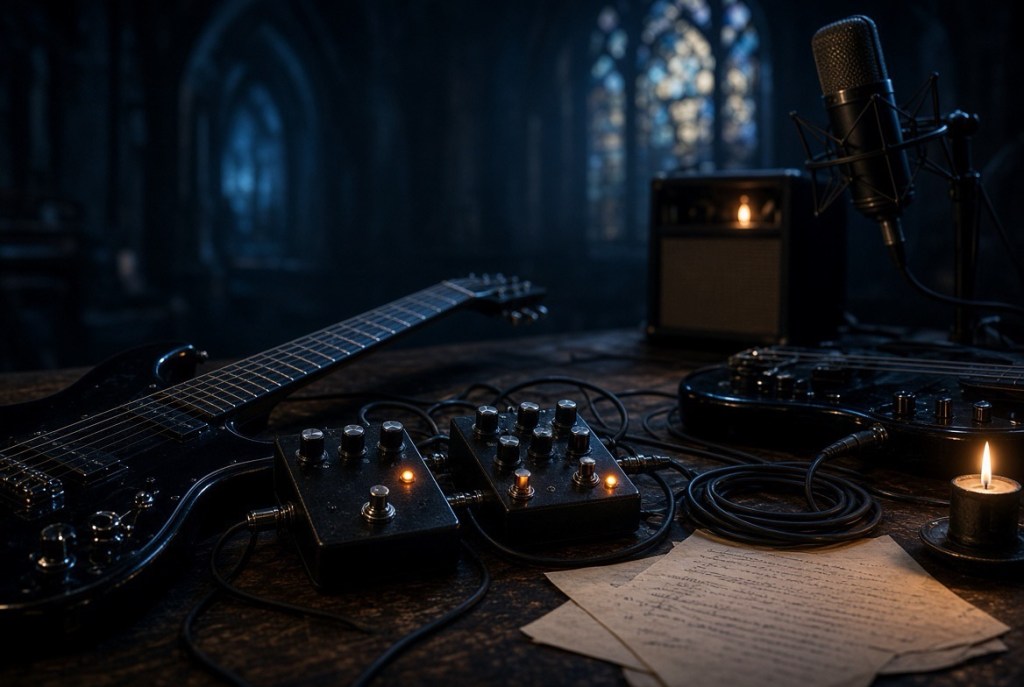
- Bass: Precision-style, Jazz, or Rickenbacker. Played with fingers or a pick. Sometimes fretless for a mournful slide.
- Guitar: Jaguar, Jazzmaster, SG, or any guitar that can stay chiming and slightly thin. Humbuckers for warmth, single-coils for brittle shimmer.
- Drums: Live kit or drum machine (LinnDrum, DMX, 808-adjacent samples). Both are historically valid.
- Keys: Organ, cold analog pad, Juno-style chorus pad, piano used sparingly.
- Voice: Baritone, alto, or theatrical tenor. Clarity and character beat range-showing.
- Optional color: 12-string, e-bow, sitar-ish textures, bells, choir, found-sound ambience.
Amp reference that keeps coming back: a clean-ish solid-state chorus amp (the Roland JC-120 tradition) or a slightly driven tube amp kept well below modern metal gain.
EQ: keep the crypt, lose the mud
Use EQ to make rooms, not to make everything “big.”
- High-pass almost everything that is not bass or kick around 80–120 Hz.
- Cut 200–400 Hz on guitars, pads, and sometimes vocals. That band is where gothic mixes turn to soup.
- Kick: give it a clear thump (often 50–80 Hz) and a short click higher up. Do not let it fight the bass fundamental.
- Bass: keep the body around 80–200 Hz; add a little mid grit (700 Hz–1.5 kHz) so the line is audible on small speakers.
- Guitars: scoop a little low-mid, then add presence around 3–5 kHz if the part needs to cut. Do not boost lows just because the song is “dark.”
- Vocals: gentle low cut, tame boxiness around 300–600 Hz, add presence around 3–6 kHz for consonants. Darkness comes from the arrangement and reverb, not from burying the singer.
A useful rule: if two parts occupy the same midrange, one of them must get quieter or narrower.
Vocals
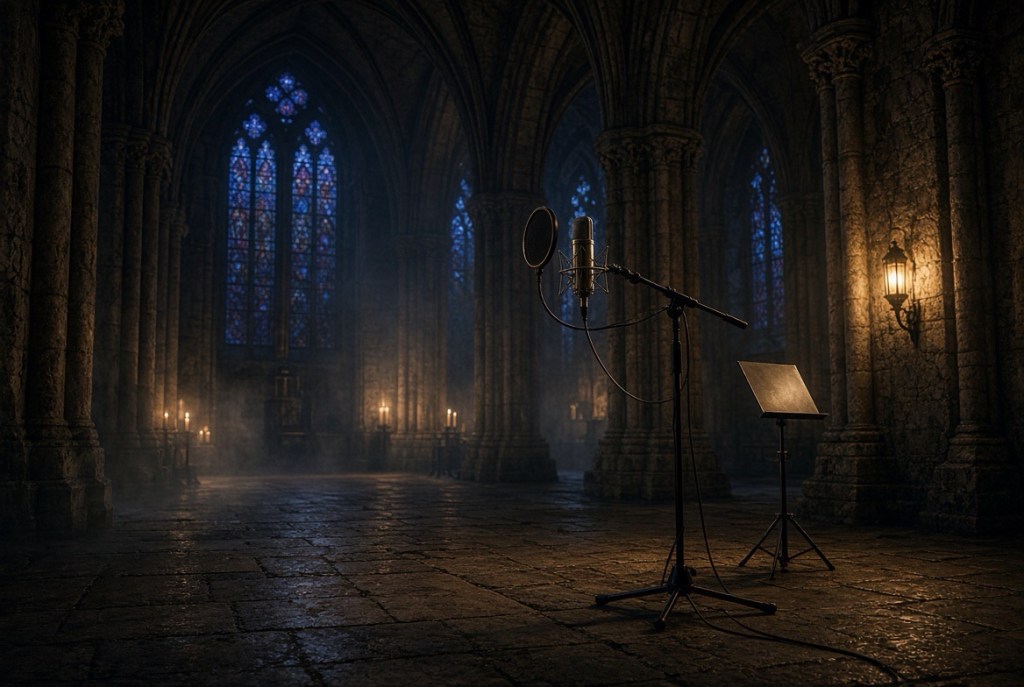
Goth vocals are theatrical without needing to be operatic. They can be spoken, half-sung, icy, or almost liturgical. What they should not be is casually mumbled into a tiny pop reverb.
Record relatively dry. Then:
- Compress gently so whispers stay audible.
- Add pre-delay before a plate or hall reverb so the first syllable stays close.
- Use a quarter-note or dotted-eighth delay at low mix for distance.
- Double the chorus, pan the doubles, keep one center take dry-ish.
- A little tape saturation or light distortion can add graveyard grit. Do not turn the singer into a metal scream unless you have left classic goth behind.
The vocal should sound present and far away at the same time. That contradiction is the genre.
Drums
Two classic lanes:
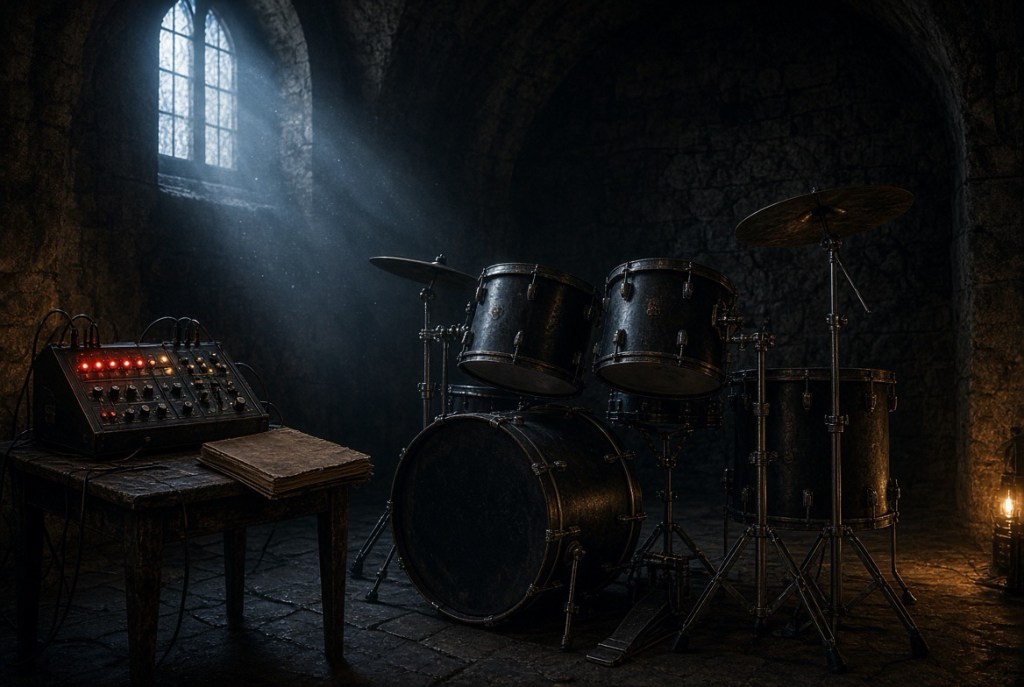
Live / tribal: snare on 2 and 4, roomy toms, sparse hats, dramatic fills that arrive late. Think procession more than blast beat.
Machine / cold: tight samples, gated snare, almost no wash, a slightly inhuman grid. Sisters-of-Mercy and later darkwave live here.
Processing that reads as goth:
- Short, punchy kick.
- Snare with plate or hall, sometimes gated so the reverb slams shut.
- Toms with more decay than the kick.
- Hats dry. Washy hats make the track sound like ordinary alternative rock.
- Parallel compression for punch without crushing the ghost notes.
If you program drums, humanize the toms and leave the kick/snare relatively strict.
Bass
This is the lead instrument wearing a disguise.
Write lines that:
- move in eighths or dotted figures
- outline the chord without strumming it
- answer the vocal instead of copying it
- stay repeating long enough to hypnotize
Tone:
- DI plus a lightly overdriven amp is a strong recipe.
- Compression for even sustain.
- Subtle chorus or ensemble on one layer, dry punch on another.
- A little mid distortion so the melody cuts.
- Sidechain lightly to the kick only if the low end is fighting.
If you remove the guitar and the song still feels like a song, the bass is doing its job.
Guitar FX
Effects are the guitar tone more than the amp is.
Core chain, in a useful order:
- Light overdrive or low-gain distortion (optional)
- Chorus or flanger
- Delay
- Reverb
Starting points:
- Chorus: the signature swirl. Slow rate, moderate depth. Stereo if you can.
- Flanger / phaser: colder and more metallic than chorus. Use for accents, not always for the whole song.
- Delay: dotted eighth or quarter note, 15–30% wet for rhythm parts; longer and wetter for leads and fragments. Ping-pong delay is very on-genre.
- Reverb: spring for garage-crypt, plate for shimmer, hall for cathedral. Long decay, but keep a dry core so notes do not dissolve.
- Tremolo: for unease and pulse.
- E-bow / volume swells / harmonics: instant atmosphere without extra chords.
Gain stays low to medium. Goth guitar should gleam, scrape, or hover. It should not sound like a modern high-gain rhythm stack unless you are writing gothic metal.
Playing tips that matter as much as pedals: leave rests, use arpeggios, let one delayed note hang, do not fill every bar.
A simple arrangement map
- Intro: delayed guitar figure + bass motif + almost no drums
- Verse: bass and drums locked, vocal close, guitar answering in the gaps
- Chorus: wider chorus guitars, extra reverb send, optional pad or choir
- Bridge: strip back to drums and bass, or go almost ambient
- Outro: let delay and reverb take the last word
The easy route via Suno
If you want the atmosphere first and the craft second, generate a reference in Suno with a style prompt such as gothic rock, post-punk, cavernous reverb, melodic bass, chorus guitar, cold drums, haunting baritone vocal, minor key, 120 bpm — then steal the structure, rewrite the lyrics, and rebuild the parts yourself so the song still has a human pulse.


Leave a Reply