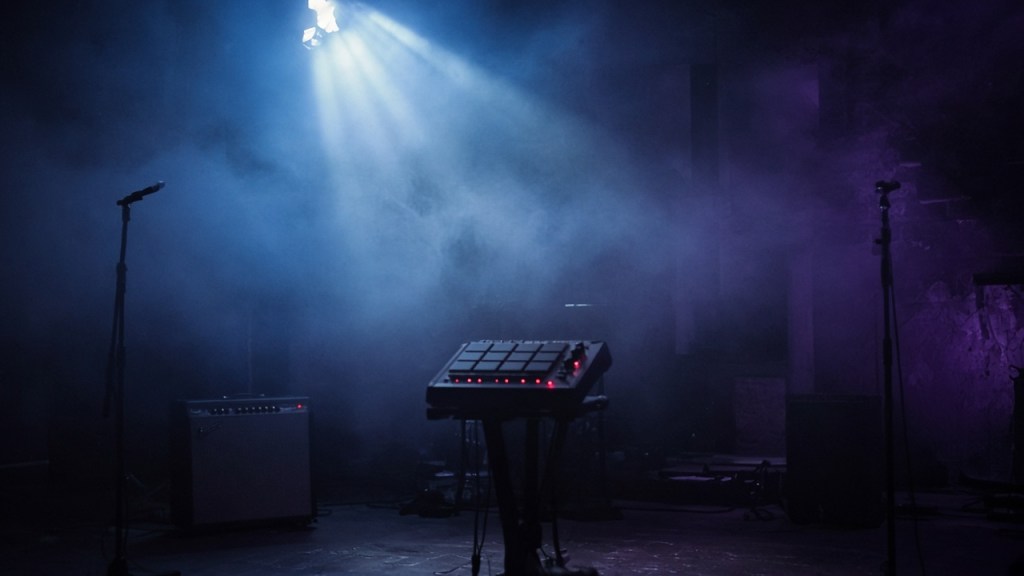
The Sisters of Mercy never had a human drummer for long. From 1981 onwards their beat came from a drum machine the band named Doktor Avalanche, and that name has passed from box to box ever since. In order, the Doktor started as a Boss DR-55. Then came a Roland TR-606, a TR-808 and, briefly, a TR-909. An Oberheim DMX took over for First and Last and Always. For Floodland it was a Yamaha RX5 and an Akai S900 sampler, and later Akai S1000 and S3200 samplers took the job. Here is how each machine got there, and what it means if you want that sound in your own music.
Why the Sisters swapped a drummer for a machine
The band formed in Leeds in 1980. On their first single, Andrew Eldritch played the drums himself. After that he handed the job to a drum machine so he could concentrate on singing. Eldritch also took charge of programming the Doktor, alongside writing lyrics and producing the records.
The machine was never treated as a gadget. The band credited it as a member. When International Musician interviewed Wayne Hussey in July 1985, the writer was surprised to see “Doktor Avalanche — drums” on the sleeve of First and Last and Always. He asked why the band had dropped their drummer. Hussey’s reply: “Doktor Avalanche is the drum machine.”
That joke turned into something lasting. Across all the line-up changes, splits and fallings-out, Eldritch and the Doktor are the only two constants on all three Sisters studio albums.
The early Doktors: Boss DR-55 and Roland TR-606
The first Doktor was a Boss DR-55 “Doctor Rhythm”, which is where the name came from. The band’s own tech pages remember it as very basic: four sounds (kick, snare, rimshot and hi-hat), one mono output, an eight-step grid, and no way to save patterns once the power went off. The band’s verdict was that it “didn’t sound bad, exactly, just … primitive.”
Next came the Roland TR-606 Drumatix. It had a few more sounds, more memory and separate volume controls, and the band say simply: “We liked it.” The 606 has turned up on this blog before, because it is one of the great underrated boxes of the era. If you want more on that little silver machine, read Gear Desk: The Roland TR-606 and Roland TR-606: Popular Users.
The Roland TR-808 years (and a brief TR-909)
The TR-808 followed. It brought individual outputs, tunable drums and enough memory to work with. The band called it “really the first serious drum machine”. They were not starry-eyed about it, though: the kick and snare “still needed savage eq” and the toms were “a complete waste of time”. They also point out, with some pride, that they were using 808 sounds in rock music years before the machine became fashionable in the acid house era.
The Doktor’s history also includes a good touring story. Guitarist Ben Gunn once pressed the 808’s “dangerous red button” just before a gig in Brussels. That wiped the patterns, so Eldritch had to reprogram the whole machine while everyone else tuned up.
A TR-909 came in briefly. The band’s view was that only its cymbals and hi-hats were a real step up from the 808.
Oberheim DMX: the First and Last and Always Doktor
By the time the band made their first album, released in 1985, the Doktor was an Oberheim DMX. Several things made it a big step up for a working band:
- It had a much bigger memory.
- It could sync accurately to tape, and patterns could be backed up to cassette.
- Each drum could be tuned, and Oberheim offered alternative sounds.
- Hits could be placed around the beat, not just on it, so the machine could play flams.
The band preferred it to the more expensive LinnDrum, which they felt sounded “too sterile”. Hussey, who knew the DMX from earlier work, told International Musician that its sounds were “very middly”. That meant you could push them to extremes, whereas a Linn “just sounds like a Linn, while the DMX sounds like a drum machine”. He also explained the split in programming duties: he programmed the DMX on tour, and Eldritch did it in the studio as well.
Not everything about the DMX was perfect. The band found its kicks “a bit flabby” and the snare “maybe not quite tight enough”, but they liked the toms.
Floodland: Yamaha RX5 and the Akai samplers
Floodland (1987) is where the Doktor stopped being a single drum machine and became a system. Eldritch had spent his money on a computer and a sequencer. He then needed a reasonably priced MIDI drum machine with a tighter snare, so he bought a Yamaha RX5 and wrote the album with it.
By the time the album was recorded, the band had an Akai S900 sampler, which they called “like manna from heaven”. Before that they had been triggering captured drum sounds with sampling delay units and chains of carefully tuned gates. According to the band, most of the drums on Floodland came through the Akai. The toms were resampled from the old DMX and from tape, and resampled RX5 kick, snare and hi-hats made up the rest.
The band say the S900’s grainy sound could be an advantage. They later moved to an Akai S1000 as the core of the live Doktor and used an Akai S3200 for recording.
The digital Doktor
The Doktor’s “brain” became a computer. The first was a Compaq 286 Portable, the main workhorse on Floodland, running a sequencer program called Sequencer Plus. Compaq Portable III machines followed. When those got too old to repair, the band had a new rugged rig built by a defence contractor in Leeds.
Wikipedia, citing a 2011 New Zealand radio interview, reports that Eldritch said the Doktor was by then a MacBook Pro running Steinberg Cubase. On stage, someone still has to run it. Simon Denbigh and Ravey Davey both served as “Doktor Avalanche operator” over the years, and since 2023 the job has fallen to Chris Catalyst, who first played guitar with the band in 2005.
How to get a Doktor Avalanche-style beat today
You don’t need an original DMX to borrow the idea. A few things matter more than the badge on the box:
- Treat the drum machine as a band member, not a metronome. Write the beat early and let the bass and guitars lock to it, rather than adding it at the end.
- Keep the pattern steady and driving. Sisters songs rarely rely on busy fills. The power comes from a beat that just keeps going while the guitars swirl around it.
- Use the right family of sounds. Roland 606 and 808 kits suit the early singles. DMX-style samples suit the First and Last and Always period. Tight, slightly grainy sampled kits suit Floodland. Roland’s TR-06 and Behringer’s RD-6 are affordable modern takes on the 606 if you want hardware.
- EQ hard. The band themselves said their 808 kick and snare needed “savage eq”. Don’t be shy about cutting mud and pushing the attack.
- Mind the room. Put the drums in a big, dark space, then keep the vocal readable on top. There is more on that in How to Write Goth Music II.
For the wider picture of the boxes that shaped this era, including the LinnDrum, the Oberheim family and the Roland line, see Post Punk Drum Machines and Other Gear.
Where to start listening
To hear the Doktor change over the years, play the albums in order. Start with the early singles collected on Some Girls Wander by Mistake (1992). Then move to First and Last and Always (1985) for the DMX years, and finish with Floodland (1987) for the sampler era. It is the same Doktor, but each era sounds different.
Sources: the band’s own “Sisters Tech – Doktor” page (thesistersofmercy.com/tech/doktors.htm); Wayne Hussey interview, International Musician, July 1985 (archived at muzines.benhall.co.uk); Wikipedia, “The Sisters of Mercy”.


Leave a Reply