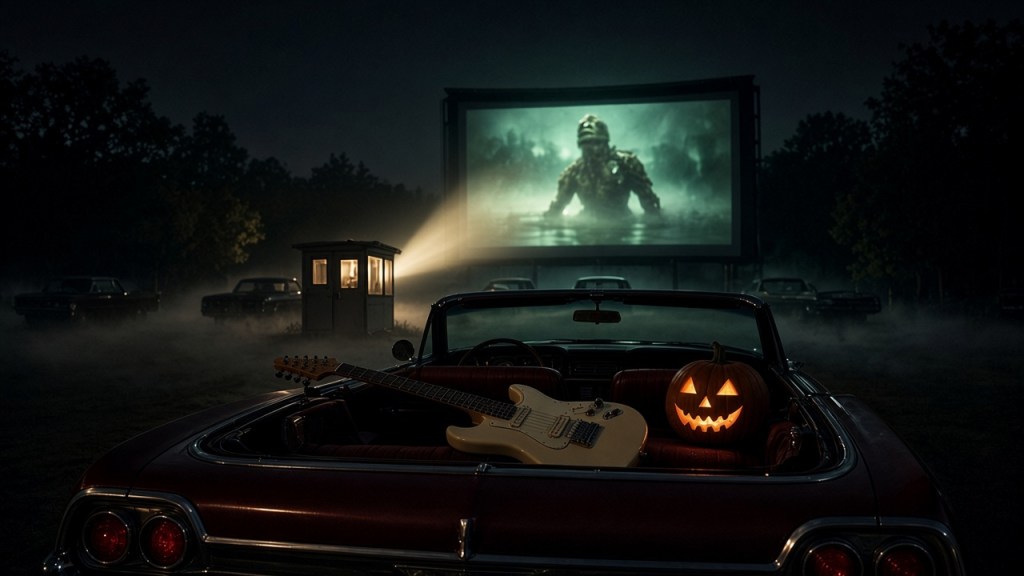
Horror surf, or spooky surf, is instrumental surf rock dressed up for a monster movie. It keeps the classic early-60s sound: twangy electric guitar soaked in spring reverb, fast picking, a driving beat and very few vocals. Then it adds B-movie titles, minor-key menace, organs, masks and stage shows full of cobwebs and fake tombstones. The style grew out of the original surf boom and garage rock, picked up a punk edge from bands like The Cramps, and took off as its own scene from the mid-90s. Here’s where it came from, what it sounds like, and a listening list to get you started this Halloween.
What does horror surf sound like?
If you know regular surf instrumentals, you already know the core of it:
- Wet, splashy guitar. Spring reverb turned way up, so every note crashes like a wave or echoes like a crypt.
- Fast tremolo picking. One note picked over and over, very quickly, often sliding down the neck.
- Minor keys and exotic scales. These are what make a beach tune sound like a chase through a haunted fairground.
- Instrumentals first. The guitar does the singing. Any vocals tend to be shouts, screams or campy narration.
- The look. Masks, monster make-up, go-go dancers and horror films projected behind the band are all part of the show.
The fun of it is the contrast. It’s party music with a shiver running through it, closer to a drive-in creature feature than to anything truly grim.
The roots: Link Wray, Dick Dale and the first surf boom
Two records from the original era explain a lot of what came later.
Link Wray & His Ray Men – “Rumble” (1958). It’s not strictly surf, but it sits at the root of the menacing side of instrumental rock. It was built on distortion, power chords and tremolo, and the title sounded so much like a street fight that some radio stations refused to play it. That was quite an achievement for a record with no words at all.
Dick Dale and His Del-Tones – “Misirlou” (1962). Dale, known as “The King of the Surf Guitar”, made reverb a trademark of the surf sound. He also drew on Middle Eastern scales from his Lebanese family background. His version of the old folk tune “Misirlou” turned it into a surf standard, and it found a whole new audience when it was used in Pulp Fiction in 1994. The speed, the exotic scale and the sense of danger in that track run straight through horror surf.
Surf rock as a chart style was at its peak from about 1958 to 1964. The music never really went away, though. It just went underground and waited for someone to dig it up.
The Cramps and the punk connection
The bridge between 60s surf and modern horror surf runs through The Cramps. Formed in 1976 around singer Lux Interior and guitarist Poison Ivy, they mixed punk with rockabilly and garage rock, with plenty of B-movie imagery along the way. They’re credited as the pioneers of psychobilly. Their debut album, Songs the Lord Taught Us, came out in 1980.
Their link to horror surf is obvious on “Surfin’ Dead”, which they recorded for the soundtrack of The Return of the Living Dead (1985). It’s a surf beat wrapped around a zombie film, and that is more or less the whole genre in one song.
The 90s spooky surf revival
In the mid-90s a new wave of instrumental bands in California picked up where the 60s left off and leaned right into the monster theme.
The Ghastly Ones (Van Nuys, California) are often described as the first band built entirely around the “spooky surf” idea. They were formed by two special-effects make-up artists who made movie monsters for a living. Fittingly, their first show was at Al’s Bar in Los Angeles on Halloween 1996, with tombstones and cobwebs decorating the stage at early gigs. Rob Zombie released their debut album, A-Haunting We Will Go-Go (1998), on his Zombie-A-Go-Go label. Their music was later used in the SpongeBob SquarePants Halloween episode “Scaredy Pants”.
The Bomboras (Los Angeles) also signed to Zombie-A-Go-Go in 1997. They performed in Day of the Dead costumes and were known for wild live shows with go-go dancers, fire-breathing and smashed equipment.
Los Straitjackets (Nashville) aren’t a horror band as such. They’re worth knowing, though, because they made the masked instrumental surf band famous. They play in matching black suits and Mexican wrestling masks, a tradition that started almost by accident at their first gig.
Messer Chups and Zombierella: horror surf goes global
You don’t have to be from California to play it. One of the best-known modern horror surf bands is Messer Chups from St Petersburg, Russia. Guitarist Oleg Gitarkin (also billed as “Guitaracula”) formed the band in the late 1990s, and the line-up now includes bassist and vocalist Svetlana “Zombierella” Nagaeva. They mix surf with samples from old film soundtracks, lounge music and more, and their live shows feature projections of old horror and sci-fi films. Gitarkin has named Link Wray and The Ventures as influences, which brings the story full circle.
In an interview with Bandcamp Daily, Zombierella described the band as a mixture of “surf, spaghetti western, lounge, rockabilly, psychobilly, and others, spiced with a good amount of horror, sci-fi, erotica, exotica, and humor”. She also explained that they use vintage gear from the 1960s, such as Fender reverb tanks, and record on vintage tape machines. That old equipment is a big part of why the records sound like a late-night creature feature.
I’ve written about Zombierella’s work before. She also plays with Tentative Reels and The Bleak Engineers, and you can find three of my favourite releases in Zombierella: Messer Chups, Tentative Reels and Bleak Engineers. There’s also a short profile in Svetlana “Zombierella” Nagaeva.
Where to start: a horror surf listening list
Play these roughly in order. You’ll hear the sound go from the 50s to the present, getting spookier as it goes.
- Link Wray & His Ray Men – “Rumble” (1958). Where the menace in instrumental rock begins.
- Dick Dale and His Del-Tones – “Misirlou” (1962). The speed and the scale that everyone borrowed.
- The Cramps – Songs the Lord Taught Us (1980). Punk, rockabilly and B-movie horror in one package.
- The Cramps – “Surfin’ Dead” (1985). From The Return of the Living Dead soundtrack.
- The Ghastly Ones – A-Haunting We Will Go-Go (1998). The spooky surf blueprint, made by monster makers.
- Los Straitjackets. Any of their records, if you want masked instrumental surf at its tightest.
- The Bomboras. Their late-90s records are the wilder, garage-punk end of the scene.
- Messer Chups – Church of Reverb (2013), Spooky Hook (2015) and Taste the Blood of Guitaracula (2017). The modern, worldwide take, with Zombierella on bass.
Throwing a horror surf Halloween
Horror surf may be the best Halloween party music there is. It’s spooky without being heavy, nearly all instrumental so people can still talk over it, and you can dance to it. A few ideas:
- Put an old monster film on mute and play the records over it, the way Messer Chups project horror films behind their live shows.
- Mix it with your other October favourites. It sits well next to garage rock, rockabilly and darker post-punk. If you want something colder for later in the night, try my own 13 Tracks for a Darker October.
- Go full B-movie. Cobwebs and cardboard tombstones worked for The Ghastly Ones’ first Halloween gig, and they’ll work for your living room.
Turn the reverb up, turn the lights down, and let the guitars do the screaming.
Sources: Wikipedia entries for Surf music, Dick Dale, “Misirlou”, “Rumble”, The Cramps, The Return of the Living Dead (soundtrack), The Ghastly Ones, The Bomboras, Los Straitjackets and Messer Chups; Bandcamp Daily, “The Rip-Roaring Sound of Psychobilly Around the World”.


Leave a Reply