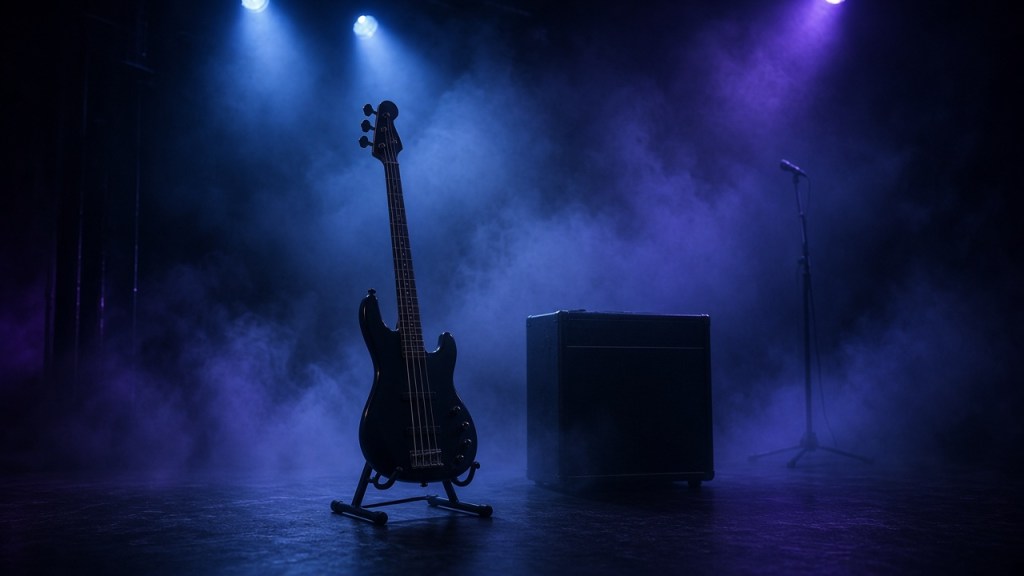
The goth bass tone is the sound that holds post-punk together. It’s bright, a little metallic, often shimmering with chorus, and played high enough on the neck that it carries the tune while the guitar sprays texture over the top. Think of the opening of “A Forest” or the riff of “She’s Lost Control”. The bass isn’t hiding under the mix. It’s the lead instrument. Here’s how that sound is built: the effects, the pick, the EQ, where you play on the neck, how to set an amp or a DI, and the classic records that show it best.
What makes a bass sound “goth”?
Most rock bass is warm, round and low, there to support the kick drum. The post-punk tone flips that around:
- Bright attack. A pick and fresh-ish strings give each note a clear click at the front.
- Pushed high-mids. The tone lives around the upper midrange, which is where melody cuts through a busy mix.
- Modulation. Chorus (and sometimes flanger) adds movement and a cold, watery shimmer.
- Melodic lines played high. Riffs sit up the neck, so the bass sings rather than thuds.
- Space around it. Drum machines, sparse drums and reverb-heavy guitar leave room for the bass to lead.
None of this needs expensive gear. It’s mostly about choices.
Chorus: the signature shimmer
If there’s one effect that says goth bass, it’s chorus. A chorus pedal copies your signal, delays it very slightly and wobbles the pitch of the copy, so one bass sounds like two players a hair apart. The result is wide, glassy and slightly seasick in the best way. The Cure’s Simon Gallup is the name most people connect with that sound.
Where to start:
- Rate low to medium, so the wobble is slow and dreamy rather than a vibrato.
- Depth around half. Too much and the notes go out of tune.
- If your pedal has a mix or level control, blend it so the dry signal is still clear.
- Use a bass chorus if you can, or one with a low-cut / crossover setting. That keeps the lowest frequencies dry and solid while the chorus works on the top end. A guitar chorus will work, but it can make the low end feel thin.
Flanger: the jet-engine swirl
A flanger works like a chorus with a much shorter delay and feedback, which gives it a sweeping, whooshing “jet plane” sound. On bass it’s best used as a colour rather than left on all night. Try it on a slow intro or a sustained note at the end of a phrase. Keep the rate very slow and the feedback (sometimes called regen or resonance) modest, or it will swallow the low end. A slow flanger sweep under a drum machine pattern is about as late-night as music gets.
Use a pick
Fingerstyle bass is warmer and rounder. A pick gives you the hard, clicky attack that defines the post-punk sound, and it’s what makes fast eighth-note lines sound driving rather than soft. Peter Hook of Joy Division and New Order played with a pick, and so did many of the players who followed.
- Thickness: a medium-to-heavy pick (around 0.88–1.14 mm) is a good start. Thin picks flap and lose punch.
- Where you pick: picking nearer the bridge sounds brighter and tighter. Nearer the neck sounds fatter.
- Downstrokes: steady downstrokes on eighth notes give that relentless, mechanical drive. Alternate picking is smoother at speed.
Boost the high-mids, don’t bury the lows
The secret of the tone is EQ, and the key area is the upper midrange. As a rough guide:
- Lows (around 60–100 Hz): keep them, but don’t boost. Too much and the bass turns to mud.
- Low-mids (around 250–500 Hz): often a small cut here clears boxiness.
- High-mids (around 800 Hz–2.5 kHz): this is the sweet spot. A boost here brings out the pick attack and the melody.
- Treble (above 4 kHz): a little adds sparkle and string noise. Too much sounds harsh, especially with chorus.
Brighter strings help too. Roundwound strings that aren’t completely dead give you that edge. Some players also add a touch of overdrive or a clean boost to make the bass growl at the top end, which suits the harder, punkier side of the genre.
Play up the neck
A huge part of the goth bass sound is simply where the notes are played. Instead of sitting on the low E and A strings near the headstock, post-punk players move up to the D and G strings, often above the 7th fret, and write lines that work as melodies. That’s the Peter Hook approach: on many Joy Division and New Order songs the bass carries the hook while the guitar plays chords or noise underneath.
Try this: take a simple chord progression, and instead of playing root notes, write a short four- or eight-note melody around the 12th fret that repeats over the whole progression. Add chorus and a pick, and you’ll hear the genre appear.
Amp and DI settings
Through an amp
- Start flat (all EQ at noon), then lift the treble and high-mid controls a little.
- Use any “bright” switch if your amp has one.
- Keep the gain clean, or just on the edge of break-up for a bit of grit.
- Go easy on the bass knob. A smaller cab or a mic’d combo often sounds more “post-punk” than a huge rig.
Recording direct (DI)
- Run your pedals into the DI box or audio interface, so chorus and flanger are recorded with the bass.
- If you can, record a clean DI alongside the effected signal. That way you can re-amp or blend later.
- In the mix, a high-pass filter around 40 Hz tidies up rumble, and a gentle high-mid boost on the bass bus brings the line forward.
- Light compression evens out picked notes. Don’t squash it, or the attack disappears.
- A touch of plate or room reverb on the bass, often frowned on in other genres, can work beautifully here.
If you work with drum machines, the bass and the machine are effectively the rhythm section, so tune their tones together. I’ve written about the drum side of that partnership in Gear Desk: The Roland TR-606 and in Post-Punk Drum Machines and Other Gear.
Classic records to learn from
The best way to learn the tone is to listen closely. These are good places to start:
- Joy Division – Unknown Pleasures (1979). Peter Hook’s high, melodic lines on “Disorder”, “She’s Lost Control” and “New Dawn Fades” are the template.
- Joy Division – “Love Will Tear Us Apart” (1980). A bass riff that carries the whole song.
- Bauhaus – “Bela Lugosi’s Dead” (1979). David J’s slow, dub-influenced line shows how much space a bass can leave.
- The Cure – Seventeen Seconds (1980), Faith (1981) and Pornography (1982). Simon Gallup’s playing on “A Forest” and “Play for Today” is chorus-era post-punk at its best.
- The Cure – Disintegration (1989). “Fascination Street” opens with one of the great basslines of the genre.
- Siouxsie and the Banshees – Juju (1981). Steven Severin’s driving bass under “Spellbound” and “Arabian Knights”.
- Killing Joke – Killing Joke (1980). The heavier, harder edge: listen to “Requiem” and “Wardance”.
- New Order – “Ceremony” (1981). Hook’s melodic style bridging into the next era.
- The Sisters of Mercy – First and Last and Always (1985). Craig Adams locking in with a drum machine.
Quick-start settings
If you just want to plug in and get close tonight:
- Pick: medium-heavy, picked near the bridge.
- Chorus: rate low, depth about half, low end kept dry if your pedal allows.
- EQ: bass flat, low-mids slightly cut, high-mids boosted, treble a touch up.
- Gain: clean, or just breaking up.
- Hands: up the neck, on the D and G strings, playing a melody rather than root notes.
Then turn the lights down, start a drum machine pattern, and let the bass do the singing. If you’re writing your own songs in this style, my guide How to Write Goth Music II picks up where this one leaves off.
Sources: Wikipedia entries for Joy Division, Peter Hook, The Cure, Simon Gallup, Bauhaus, “Bela Lugosi’s Dead”, Siouxsie and the Banshees, Killing Joke and Chorus effect.


Leave a Reply